Discover free nonprofit investing resources, including policies, guides, and templates, to keep your investment or endowment program running strong.
A clear, more reliable way to track pooled funds within a single investment portfolio
Many nonprofits manage multiple funds or endowments within a single investment portfolio. Whether it’s donor-restricted funds, board-designated reserves, or quasi-endowments, the challenge is the same:
How do you fairly track each fund’s share of the overall portfolio?
For many organizations, the answer has been spreadsheets.
Many nonprofits rely on spreadsheets to track funds within an investment pool and for good reason. They are flexible, familiar, and easy to implement, particularly for organizations managing a smaller number of funds.
But as complexity grows and organization leaders turn over, spreadsheets can become more difficult to maintain with confidence.
Common challenges:
What works well for a handful of funds can quickly become difficult to maintain, signaling that it’s time for a more structured approach.
Subaccounting or unitized accounting is a method used to track individual funds within a pooled investment portfolio. Each fund owns a portion of that pool, represented by “units,” similar to shares in a mutual fund.
This allows multiple funds to participate in a single investment portfolio while still maintaining separate ownership and reporting.
A nonprofit has three funds invested in a single portfolio:
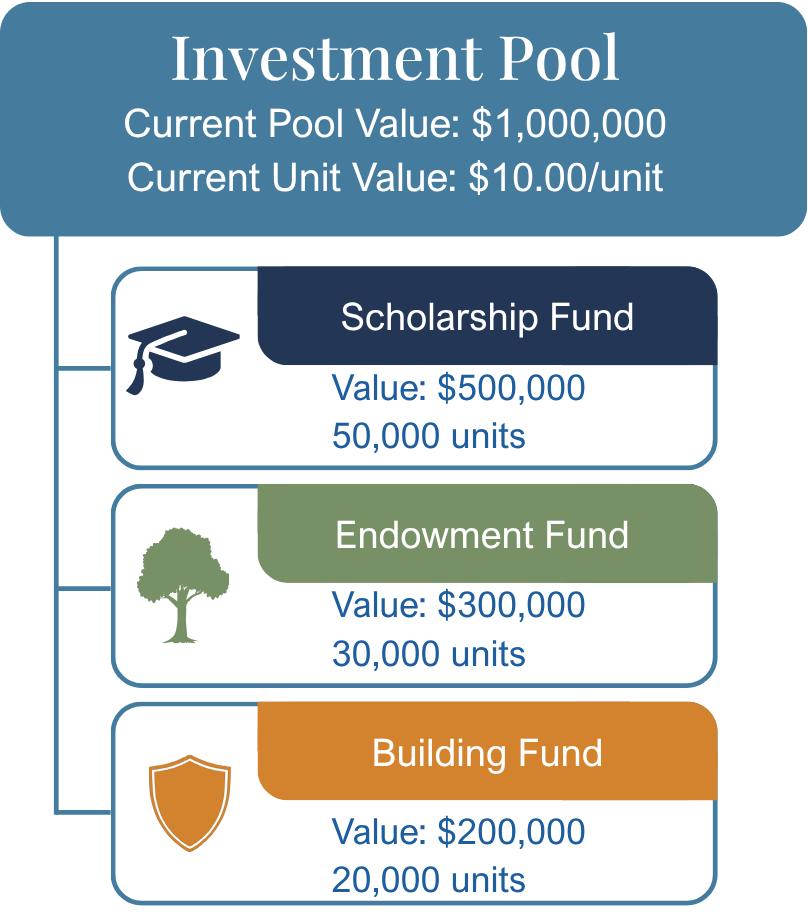
Each fund owns units in the pool based on the value of its investment. As the investment pool changes in value, the unit value changes as well.
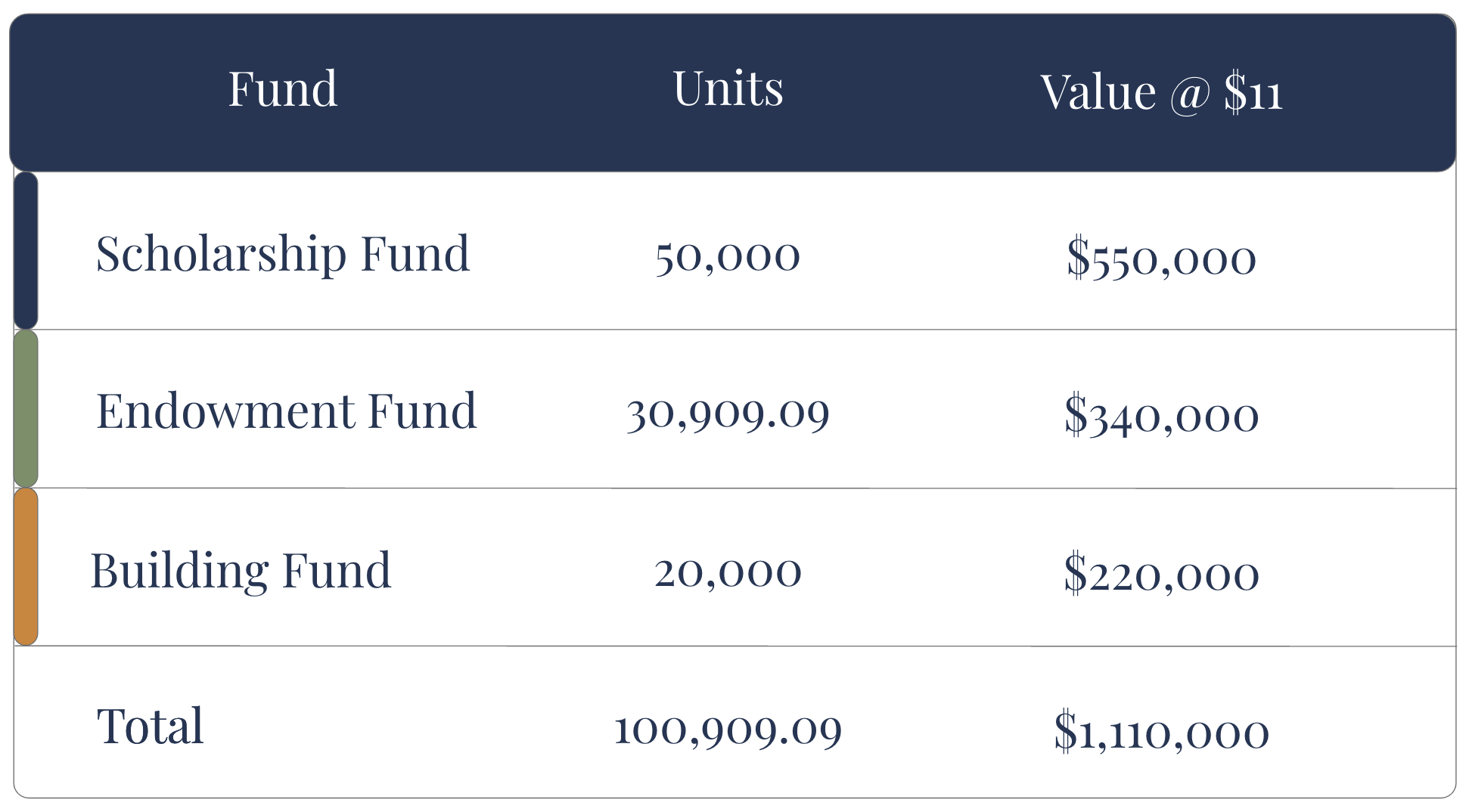
If the portfolio grows by 10%, the unit value increases from $10.00 to $11.00:

Each fund participates proportionally in the portfolio’s performance based on the number of units it owns.
Assume there is a $10,000 contribution made to the Endowment Fund during the month.
The Endowment Fund purchases additional units at the month end value of $11:
A structured approach to subaccounting helps nonprofits:
As part of our nonprofit investment services, we offer a subaccounting feature that allows organizations to move away from spreadsheets and track underlying funds within a pooled investment portfolio.
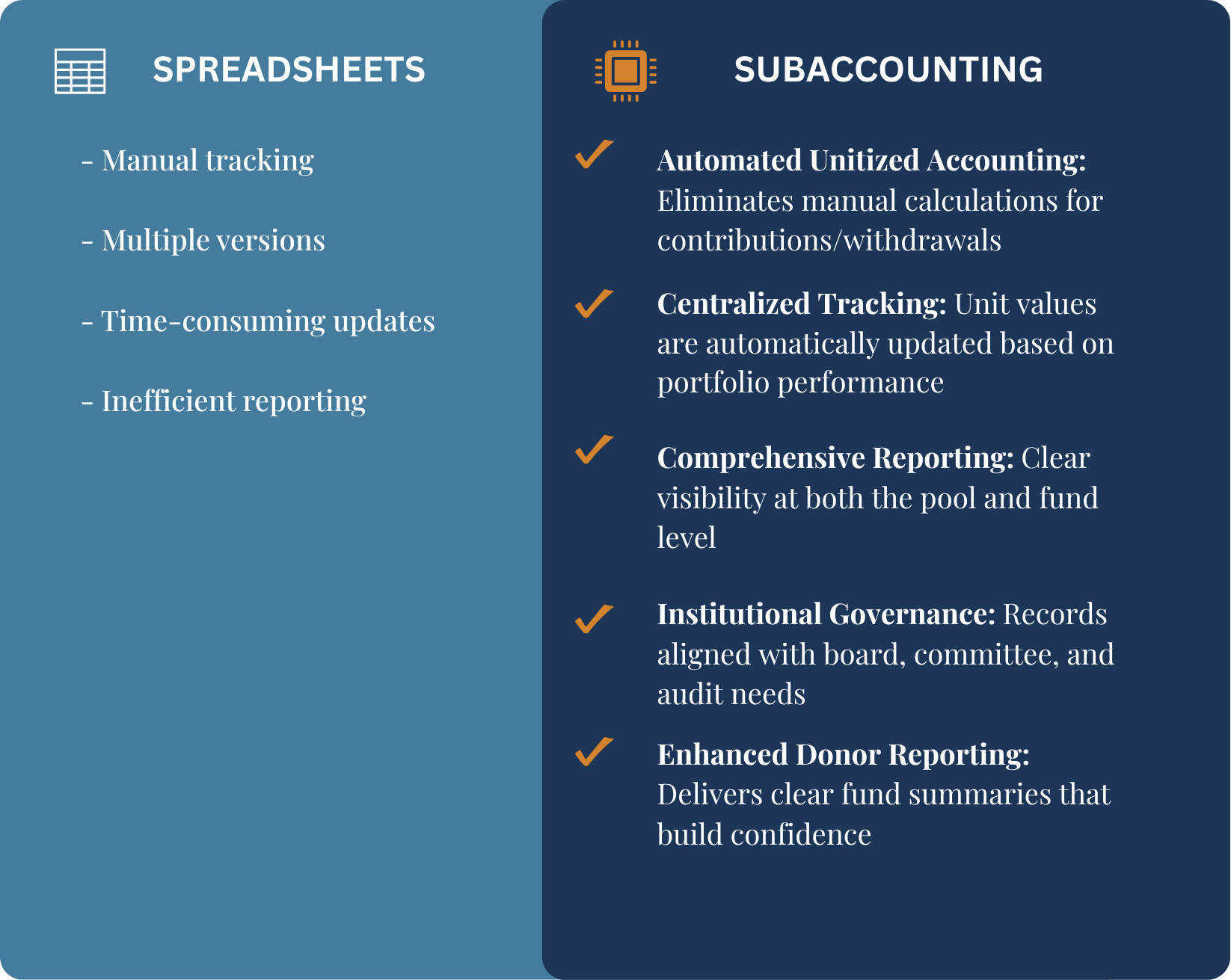
Subaccounting is an important function for nonprofits managing multiple funds within a single portfolio. While spreadsheets can serve as a starting point, they often become difficult to maintain as organizations grow.
Embracing a structured subaccounting framework allows organizations to anchor their financial operations across three critical pillars.
Subaccounting, or unitized accounting, is a method used to track individual funds within a pooled investment portfolio by assigning each fund ownership units that fluctuate in value based on portfolio performance.
As organizations manage more funds and transactions, spreadsheets can become difficult to maintain accurately due to manual calculations, version control issues, and increasingly complex reporting requirements.
Unitized accounting helps nonprofits allocate returns fairly, automate contributions and withdrawals, improve fund-level reporting, reduce administrative effort, and strengthen transparency for boards, donors, and auditors.

Download our full article and Subaccounting Readiness Checklist to evaluate whether your organization would benefit from a more structured approach to fund tracking.



We'd like to learn more about your organization and understand your unique investment needs.
Or call: (608) 291-4646
Get notified of new guides and resources and receive monthly market commentaries.
Schedule a time to speak with a nonprofit investment advisor
Whatever your investment needs, our advisors are here to answer questions or explain your investment options in more detail.
(608) 291-4646 or hello@getecio.com
Select a meeting type:

15-Minute Question & Answer Session
Ask an advisor a question about your current or future investment program.


30-Minute Investment Overview
Learn how eCIO can help your nonprofit establish and enduring investment program.

60-Minute Consultation
Schedule a meeting with your investment committee.



Have a quick investment question?
Submit a question and a nonprofit advisor will respond promptly.


