Discover free nonprofit investing resources, including policies, guides, and templates, to keep your investment or endowment program running strong.
Learn how to build board and donor support for your nonprofit endowment by clearly communicating its purpose, long-term impact, and role in financial sustainability.
Building the confidence to bring your board and your donors along
Whether your nonprofit is considering establishing an endowment or already has one that hasn't been a strategic priority, building meaningful long-term support starts with the board.
The goal isn't simply to convince the board that an endowment is a good idea. It's to give board members enough conviction to decide what role an endowment should play in the organization's long-term financial strategy, and to speak about it credibly with the donors they know best. Making the case to your board comes first; making the case to your donors follows from it. And if you already have an endowment, there's a third situation layered on top of both: re-introducing a fund that's gone quiet.
Almost no board member objects to an endowment in the abstract. The real objection usually stems from a core question: “Is it right to hold millions in assets rather than spending it on our mission today?” Simply put: “We need this money now.”
That's a real tradeoff, and Article 1: Is an Endowment Right for Your Nonprofit Right Now? covers how to work through it: readiness, the size that actually matters, and what the fund won't solve.
The reframe that tends to move a hesitant board forward is treating the endowment less like a fundraising milestone and more like a sustainability and risk-management tool, and it helps to make that case in numbers the board can actually picture.
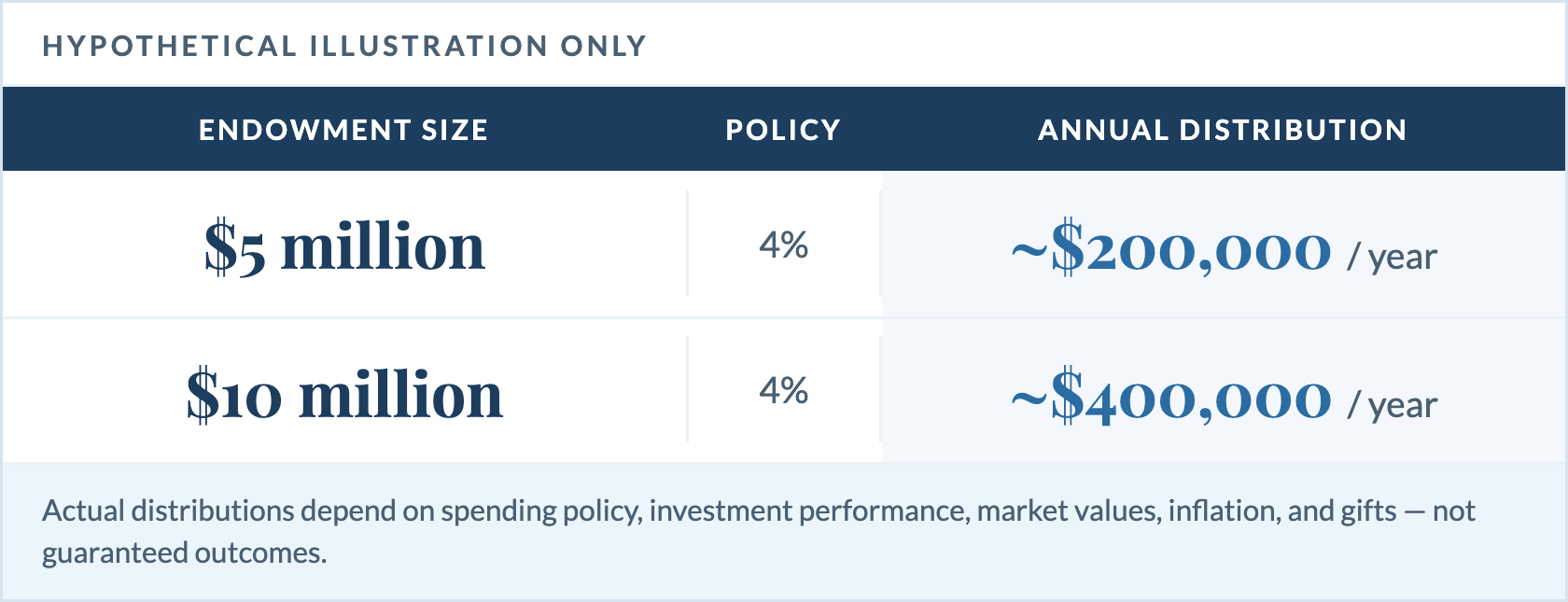
But putting dollars around the concept helps the board — and later, donors — think differently about the goal. Instead of saying, "We want to build a $5 million endowment," the organization can say, "Our long-term goal is to build a financial resource capable of contributing approximately $200,000 per year toward our mission." That connects the size of the endowment to its purpose, which is a much easier thing for a board member to repeat in a donor conversation than a raw dollar target.
Board members are usually an organization's most credible fundraisers, and they can't sell what they don't believe in. A board member who's uncertain about the endowment, or defensive about the tradeoff, tends to avoid the topic with donors, or undercuts it with hesitant language ("I guess it just sits there"). A board member who understands the strategy can instead make the ask naturally in the conversations where it matters most: at a gala table, on a call with a longtime donor, in a conversation about a bequest.
That confidence should extend to staff as well, particularly the development team, who are often the ones fielding donor questions: "Will my gift just sit in an account?" "How do I know it won't be spent next year?" "What happens to it after the current leadership moves on?" Staff need the same clarity the board has: the purpose of the endowment, the guardrails around it, and a few concrete numbers, like distribution examples. Without that, even a well-designed endowment program can go unmentioned in donor meetings simply because no one feels equipped to explain it.
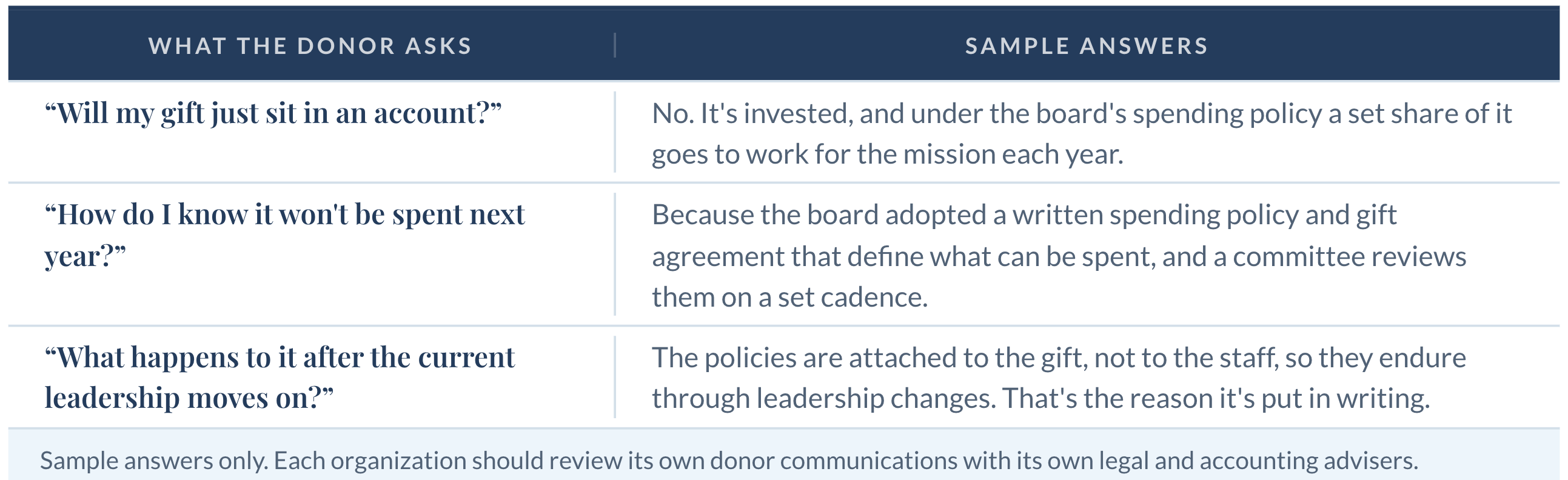
A few practical ways to build that shared confidence:
Board education isn’t just a governance step, it’s part of the development strategy.
A donor's hesitation about an endowment gift is often simple: they're being asked to give money away that they will never see spent, and without a clear reason why that's a good idea, the gift can feel less like generosity and more like money disappearing into an account. The case for an endowment gift has to answer that directly, and three points tend to do most of the work:
Those three points translate a fairly technical idea of a restricted long-term fund with a spending policy into something a donor can actually picture: not money set aside, but a gift that keeps working.
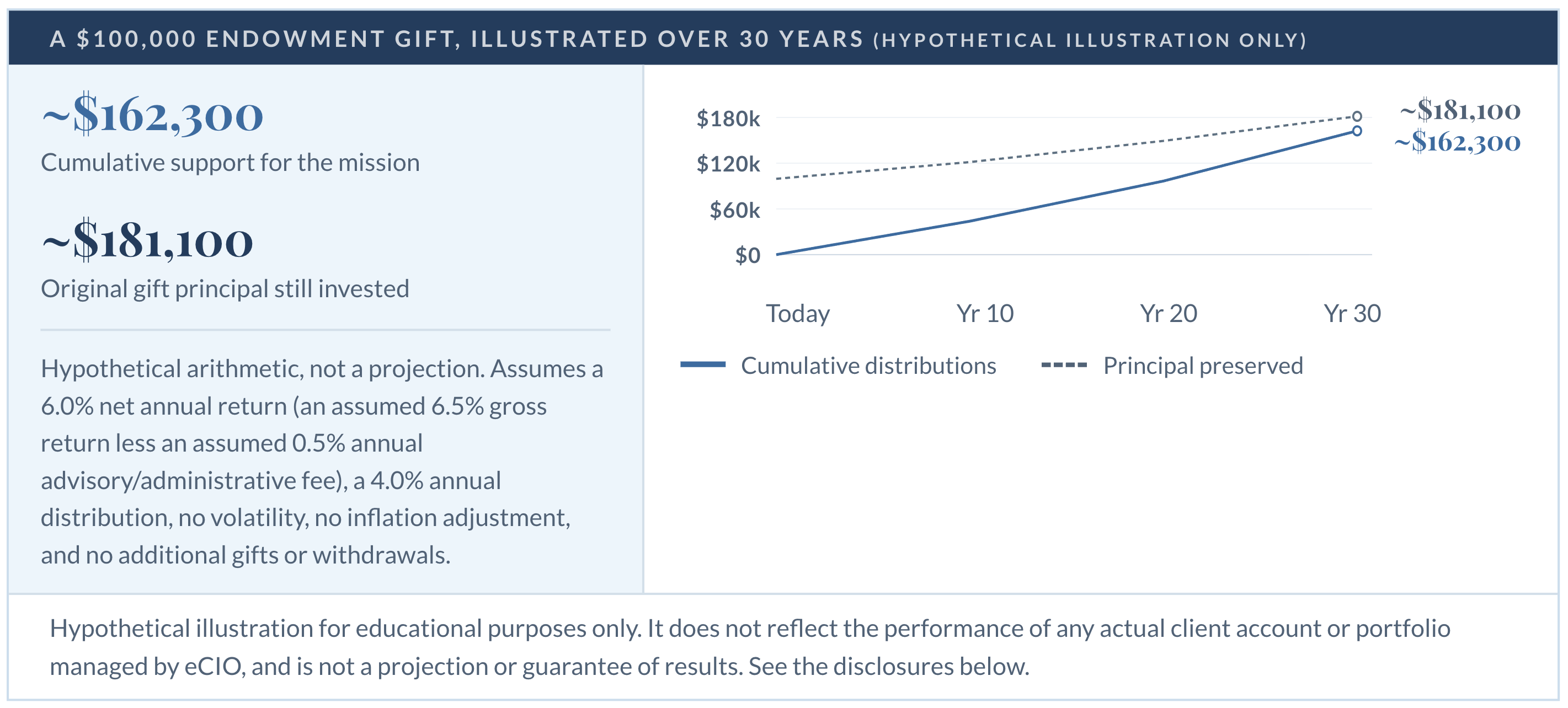
Hypothetical illustration only. The chart and figures above are hypothetical and were produced solely by arithmetic. They do not reflect the performance of any actual client account, composite, or portfolio managed by eCIO, Inc., and no client experienced the results shown. Assumptions and limitations: the calculations assume a 6.0% net annual return (an assumed 6.5% gross return less an assumed 0.5% annual investment advisory/administrative fee) and a fixed 4.0% annual distribution, applied at a constant rate in every year. Those return and fee figures are arbitrary assumptions selected for illustration; they are not derived from any index, model, or expectation of future returns, and actual fees are described in our Form ADV Part 2A. The illustration assumes no market volatility, no inflation adjustment, no taxes, and no additional gifts or withdrawals. Actual returns fluctuate, and the sequence in which they occur would materially change both the cumulative distributions and the remaining principal shown. No guarantee of results: all investing involves risk, including the possible loss of the principal amount invested; past performance is no guarantee of future results; and hypothetical illustrations cannot be relied upon to predict actual outcomes. This material is educational only and is not investment, legal, tax, or accounting advice, nor a recommendation, solicitation, or offer to buy or sell any security or to adopt any investment strategy. Each organization should consult its own legal, tax, and investment advisers.
For organizations with an existing endowment, the challenge usually isn't resistance from either audience above. It's silence.
Endowments tend to disappear from donor communications once they're established, for a simple reason: they stop feeling like news. A campaign has momentum, a launch has a story, but a fund that's just sitting there, invested, doesn't generate a natural moment to bring it up again. So it often doesn't come up, not in the annual report, not in donor conversations, not even always in board meetings, where it can settle into being a line item rather than a living asset.
That silence has a real cost. Longtime donors forget the fund exists. New donors and board members never learn about it at all. And the board itself can drift into treating the endowment as a number on a balance sheet rather than a resource with a purpose behind it. That often makes it harder to grow, and easier to overlook when other priorities compete for attention, and harder still for anyone to speak about it with the confidence described above.
Bringing it back doesn't require a new campaign. A few low-effort, recurring habits do most of the work:
Building support for an endowment isn't a one-time pitch. It’s an ongoing conversation your board has to keep choosing to have, whether you're starting from scratch or re-engaging a fund that's gone quiet. Download Building Confidence in Your Endowment: A Board Discussion Guide for three questions to help frame that conversation.
THE ENDOWMENT PLAYBOOK SERIES
Download the Board Discussion Guide for three practical questions to help your board start the conversation and determine the role an endowment could play in your nonprofit’s future.


We'd like to learn more about your organization and understand your unique investment needs.
Or call: (608) 291-4646
Get notified of new guides and resources and receive monthly market commentaries.
Schedule a time to speak with a nonprofit investment advisor
Whatever your investment needs, our advisors are here to answer questions or explain your investment options in more detail.
(608) 291-4646 or hello@getecio.com
Select a meeting type:

15-Minute Question & Answer Session
Ask an advisor a question about your current or future investment program.


30-Minute Investment Overview
Learn how eCIO can help your nonprofit establish and enduring investment program.

60-Minute Consultation
Schedule a meeting with your investment committee.



Have a quick investment question?
Submit a question and a nonprofit advisor will respond promptly.